

Sloth Encounters
Sloth Encounters owner Larry Wallach has been cited for over sixty Animal Welfare Act violations, including lying to federal inspectors and mistreating sloths. After pleading guilty to trafficking dangerous animals and being held in contempt of court, his Hauppauge facility was shut down by the New York Supreme Court, and his USDA license was canceled. Now, Wallach has fled to Florida—where he continues to illegally exhibit animals.
Who are sloths?
Sloths are gentle, tree-dwelling residents of the rainforests of Central and South America—famous for their slow pace but perfectly designed for survival. What humans see as slowness is actually nature’s genius at work. Their unhurried movements keep them hidden from predators, while their leaf-based diet and slow metabolism help them thrive high in the canopy. Evolution has even stripped sloths of the ability to regulate their own body temperature—an adaptation that conserves energy and keeps them hidden from predators’ thermal vision.
Entire ecosystems grow on their fur—algae, fungi, and even insects—turning them into living landscapes that blend seamlessly with the rainforest. Sloths emit no body odor and move so quietly that even the sharpest hunters can’t detect them. When threatened, they may simply freeze, swim away with surprising grace, or defend themselves with powerful claws and remarkable strength.
To truly understand a sloth is to see the beauty of stillness—and the perfection of a life lived gently within nature’s rhythm.
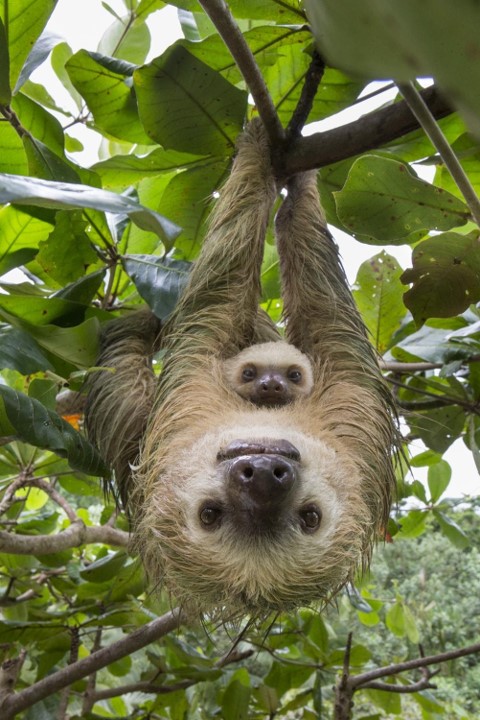
Photo: Suzi Eszterhas
Sloths are among the most unique animals on the planet, but their extraordinary adaptations also make them exceptionally vulnerable to human threats, including poaching for zoos and the pet trade. Like all evolutionary traits, every adaptation comes with trade-offs. For sloths, these include diminished hearing and vision—they are mostly deaf and nearly blind in bright daylight—and the loss of the ability to thermoregulate. This makes them entirely dependent on environmental conditions to maintain their body temperature. In cold climates, such as New York, the special microbes in their stomachs can die, preventing proper digestion and causing the sloth to starve despite a full stomach.
Rebecca Cliffe, PhD, a Costa Rica-based zoologist and founder of the Sloth Conservation Foundation, emphasizes:
“Allowing hands-on contact is not ethical. Sloths are solitary, non-domesticated animals. They are the prey, humans are the predator, and their natural response is to stay still—often mistaken as contentment. Beyond this, social media accelerates normalization of touching sloths. Photos of people holding sloths encourage tourists to seek the same experiences, increasing opportunities for exploitation in countries like Costa Rica, Colombia, and Brazil.”
Contrary to claims by exploiters, human interaction does not protect endangered sloths. Scientific studies demonstrate that the mere approach of a human triggers abnormal blood pressure reactions in sloths. Moreover, displaying endangered animals in unnatural settings can mislead the public, reducing support for real conservation efforts and increasing the desire to keep wild animals as pets (Schroepfer et al., 2011; Ross et al., 2011; Leighty et al., 2015). Casual observation of wild animals in artificial environments can also negatively impact children’s understanding of animals and their natural habitats (Jensen, 2014).
True conservation respects wildlife by minimizing interference, not exploiting vulnerable animals for entertainment or profit.
What is SLoth Encounters New York?
Sloth Encounters New York—previously known as Sloth Encounters Pet Shop and Sloth Encounters Long Island—is an unlicensed traveling menagerie that has been documented unlawfully exploiting baby sloths and other wild animals throughout the Atlantic Seaboard.
After an undercover investigation captured disturbing footage of Sloth Encounters’ staff hitting sloths, stressed sloths kept in crowded conditions, sloths fighting with one another and a wounded sloth struggling when Wallach roughly grabbed his head and neck, Sloth Encounters owner Larry Wallach had his Long Island storefront shut down by the Supreme Court; however, Wallach has continued to take animals to raucous parties for profit—recently being cited by the New York City Department of Health for exhibiting sloths, a kangaroo, and a python in New York City where they are prohibited.
In June 2024, Wallach’s license to exhibit animals was canceled by the U.S. Department of Agriculture’s Animal & Plant Inspection Service (USDA APHIS) following more than 60 violations of the federal Animal Welfare Act. Despite this, Wallach has fled to Florida and continues to exhibit animals illegally without a license.
Previously, Wallach was found in contempt of court for violating Supreme Court orders that barred him from operating. Investigations he was taking animals to unlicensed cannabis parties where the organizers alleged sloths got “high.”
According to Denise Flores—an employee of Wallach’s late business partner Sam Mazzola—Wallach’s 2023 exhibitions weren’t the first time Wallach’s animals were allegedly drugged, telling Roadside Zoo News:
[Sam] had partnered up with a man named Larry Wallach to open this store and they were bringing in cubs—like a baby white lion and a baby tiger—and Larry was drugging the babies! I caught him. After I saw him drug the cub, I grabbed the baby and stuck my finger down its throat to get it to vomit the drugs up. I confronted Larry about it, but he was one of the bosses. I’m pretty sure they kept drugging the cubs after that.

Endangering children & the welfare of animals
Exploiting animals is a long-standing pattern for Sloth Encounters’ owner, Larry Wallach. He has been cited for over sixty violations of the federal Animal Welfare Act, including “critical” violations in November 2022 for lying to USDA APHIS inspectors about a child being bitten. Suffolk County health officials noted that if the incident had involved one of Wallach’s more recently acquired sloths, public health protocols would likely have required euthanasia and rabies testing. Kangaroos—also exhibited by Wallach—cannot be vaccinated against rabies, a disease that is almost always fatal in humans without prompt treatment.
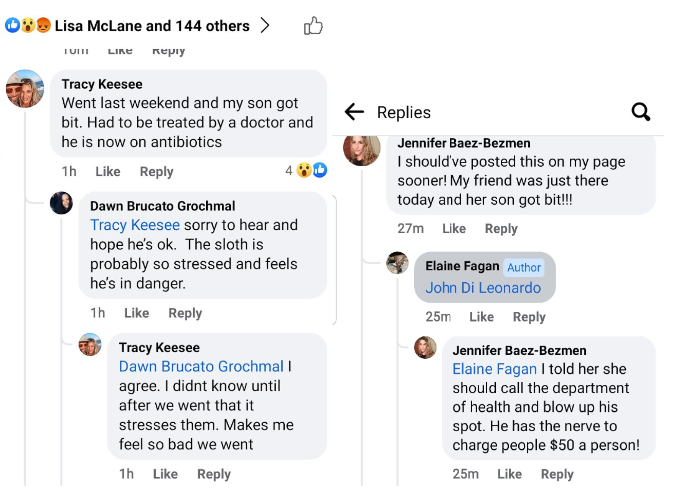
Children have been Bitten At Sloth Encounters
According to the father of this child, Wallach attempted to downplay this bite as a routine occurrence by saying his child was the fourth person to have been bit. Wallach was later cited for “critical” violations of the federal Animal Welfare Act for providing false information to USDA inspectors and for mishandling animals in ways that endangered both the animals and the public.
In October 2022, Wallach was cited for two violations of the Animal Welfare Act after failing to provide USDA APHIS inspectors with a veterinary care plan for a baby sloth. He also misled inspectors by claiming the sloths stayed at his brother’s or girlfriend’s house when the facility was closed, when in reality he was hiding them at the Best Western Mill River Manor in Rockville Centre. After the hotel’s corporate office learned Wallach was harboring sloths in violation of federal law, he was ordered to remove them and vacated the property. Wallach subsequently stayed with an employee who was squatting in a New York City apartment. Shortly thereafter, the Administration of Children’s Services took custody of two children belonging to that employee, apparently after determining they had been endangered by exposure to wild animals at Sloth Encounters.
USDA APHIS cited Wallach again in March 2023 for denying federal inspectors access to his facility, and in April 2023 for mishandling animals. An inspector observed an employee improperly feeding a baby kangaroo in a way that “can lead to aspiration and accompanying aspiration pneumonia,” and saw a sloth attempting to bite Wallach and patrons.
In August 2023, Wallach received additional citations for failing to maintain a written program of veterinary care for kangaroos, capybaras, a chinchilla, and a sugar glider, and for keeping sloths in an enclosure with insufficient humidity, which caused a baby sloth named Cosmo to scratch at his own skin.
By October 2023, Wallach was cited again for failing to maintain “a safe and effective program for the control of insects, ectoparasites, avian and mammalian pests,” after inspectors observed a large number of flies in areas housing capybaras, kangaroos, sloths, and the store kitchen.
In February 2024, Wallach was cited for three additional violations—including two “critical” violations—related to a Humane World investigation:
-
-
Improperly handling sloths during public interactions, resulting in injuries (“critical”);
-
Confining incompatible animals in the same enclosure, risking injury or death (“critical”);
-
Leaving facilities in severe disrepair, creating hazards for a kangaroo and capybaras
-
In May 2024, Wallach was cited for failing to provide disposition records for more than a dozen animals, including a degu, three sugar gliders, and ten lovebirds, after his store was shuttered by the Suffolk County Supreme Court and the animals apparently disappeared without a trace.

Just two days later, USDA APHIS issued Wallach an ‘Official Warning‘ that “if APHIS obtains evidence of any future violation of these federal regulations, APHIS may pursue civil penalties, criminal prosecution, or other sanctions for this alleged violation(s) and for any future violation(s).”
Now, operating without a license, Wallach is entirely beyond federal inspection.
Trafficking wildlife & electroshocking a juvenile tiger
Long before Wallach began exploiting sloths, he was exploiting tigers, bears, and other animals defined as “dangerous” by Title 6 New York Codes, Rules, and Regulations 180.1. After a long history of infractions, the New York State Department of Environmental Conservation (DEC) declined to renew his permit—an apparent reason why he shifted to exhibiting sloths, who are not subject to the same regulations.
One of Wallach’s earlier violations involved taking an unrestrained tiger cub to a public park, allowing the public to pet and handle the animal. A tip from PETA about Facebook Live videos—one showing Wallach electroshocking a young tiger named Sheba and threatening a dog with an electric prod—triggered multiple Animal Welfare Act citations, including a “critical” violation for failing to follow veterinary instructions in treating Sheba’s broken toe. Additional citations were issued for keeping Sheba in a dangerously deteriorated enclosure with broken floorboards and for putting her and a wolf at risk by allowing unsafe interactions.
Despite losing his license to possess “dangerous” animals, Wallach pleaded guilty to state charges of illegal possession with intent to sell Nile monitors—venomous reptiles that can grow up to seven feet long—following a 2023 Humane Long Island investigation.
A few months later, Wallach was linked to an investigation by the Florida Fish & Wildlife Commission (FWC) regarding the alleged unlawful trafficking of Kodiak bear cubs from a roadside zoo in New Jersey to an unlicensed individual, named Shae Hensley, who admitted to training the bears for shows in Florida. The baby bears eventually escaped, roaming the neighborhood.
Wallach has denied involvement with these bears, but photographs from his now-shuttered storefront show him holding one of the cubs while they were so young that their eyes had not yet opened.


Mr. & Mrs. Prickles
On the same day the baby bears were photographed, Wallach received two baby porcupines. Tragically, according to whistleblowers, Mrs. Prickles died from hypothermia the first night, and Mr. Prickles later died from improper feeding. Their tiny bodies were photographed inside Sloth Encounters’ freezer.
What humane long island is doing to help

-
Protests and Official complaints
Public protests and official complaints filed by Humane Long Island, along with our ongoing investigations, have had a major impact. These efforts have led to Larry Wallach being cited for “critical” violations of the Animal Welfare Act, pleading guilty to wildlife trafficking charges, being held in contempt of court, the closure of his storefront, and the cancellation of his scheduled exhibitions. Our work has also prompted law enforcement action, Supreme Court orders, and more than a hundred media reports warning the public to avoid Sloth Encounters.
You can help ensure these animals are protected. Report Wallach’s illegal exhibitions to the USDA and urge authorities to confiscate the animals. If authorities allow us to intervene, Humane Long Island has already secured placement for the sloths at a reputable sanctuary, where they can live safe, natural lives.
If you have information or evidence of Wallach’s ongoing exhibitions anywhere in the United States, please contact us immediately. Every tip brings us closer to stopping this exploitation.

Did you know?
Exploiting wild animals at schools and parties sends children the harmful message that animals exist for our entertainment and profit. Research shows these interactions can actually undermine real conservation efforts, creating the false impression that wild populations are safe and reducing support for protecting them.
-
Lobbying to restrict traveling wild animal acts and close loopholes in State Law
Humane Long Island recently worked with lawmakers to restrict traveling exotic animal acts across Suffolk County. Now, we’re fighting to end the sale and exploitation of exotic animals—including sloths, kangaroos, and capybaras—in New York. We’re working with Senator Monica Martinez and Assembly Member Linda Rosenthal on legislation to protect these vulnerable animals, but the fight isn’t over: while Senator Martinez’s bill has passed the Senate multiple times, its Assembly companion bill remains stalled in the Environmental Committee.
You can help. Sign up for our newsletter to be the first to know when the bills are reintroduced and take action to ensure these animals are never sold to the public. Together, we can put an end to their suffering.
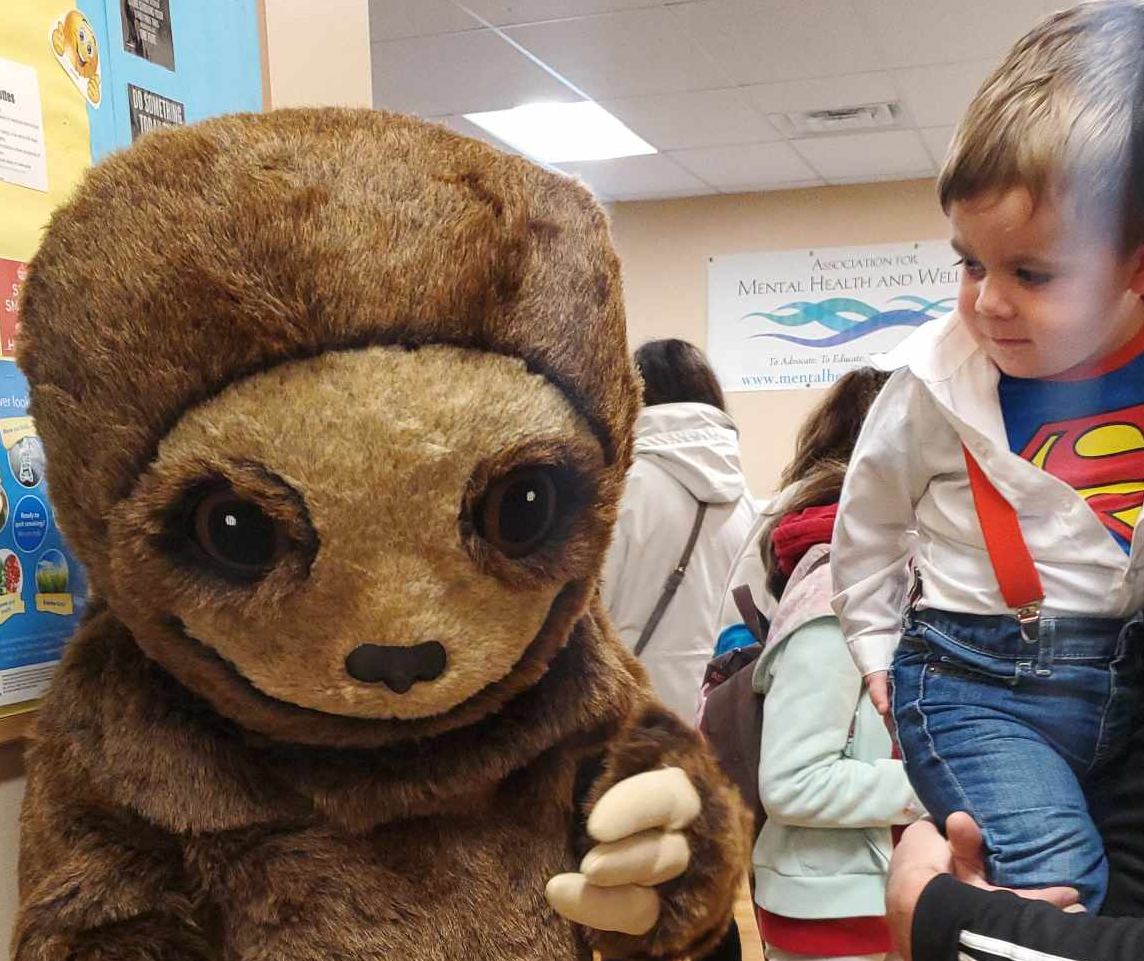
Humane Education
Kids love meeting our friendly “sloth” mascot and learning from our expert team of anthrozoologists and wildlife rehabilitators—professionals who, unlike the animals, perform for the sheer joy of education and entertainment!
Our lesson plans can be customized for all ages—from pre-K through university—and may include stickers, activity books, puppets, and hands-on activities. We are especially passionate about engaging neurodivergent students in fun, accessible, and meaningful ways.