Holtsville Ecology site
After a year-long campaign by Humane Long Island, the Brookhaven Town Board voted unanimously to close the Holtsville Ecology Site—a roadside zoo run by the Town of Brookhaven Highway Department atop an uncapped landfill. The closure came after more than a dozen whistleblowers revealed that animals at the zoo suffered from painful illnesses and, in some cases, even froze to death—claims corroborated by independent investigations in Newsday and The New York Post.
What was the Holtsville Ecology Site?
Founded in 1979 on the site of an uncapped landfill, the Holtsville Ecology Site is an unaccredited, municipal roadside zoo run by the Town of Brookhaven Highway Department. Contrary to the narrative that all of the animals at the landfill were rescued, Humane Long Island has found that many of the more than 100 wild and farmed animals confined to chain-link and concrete enclosures on the property were either bred there or dumped there by notorious animal exhibitors like Sloth Encounters‘ owner Larry Wallach who was once a director of the roadside zoo.
Honey the bear—who was dumped at the Ecology Site by Larry Wallach after she became too old for cub photo ops—was “euthanized” in December 2024, just 3 months after Humane Long Island urged the Town to have her evaluated by a large animal veterinarian and moved to a Global Federation of Animal Sanctuaries accredited facility. The timing of her death, the mystery of its circumstances—first being reported as a natural death and then later as euthanasia just 3 weeks after the Town told Humane Long Island she was “fine” and “healthy”—and the rapid “euthanasia” of several other animals brought to the attention of town officials at this meeting, is troublesome and what forced Humane Long Island to make these conversations public with explosive independent investigations by Newsday and The New York Post after 3 months of private negotiations.
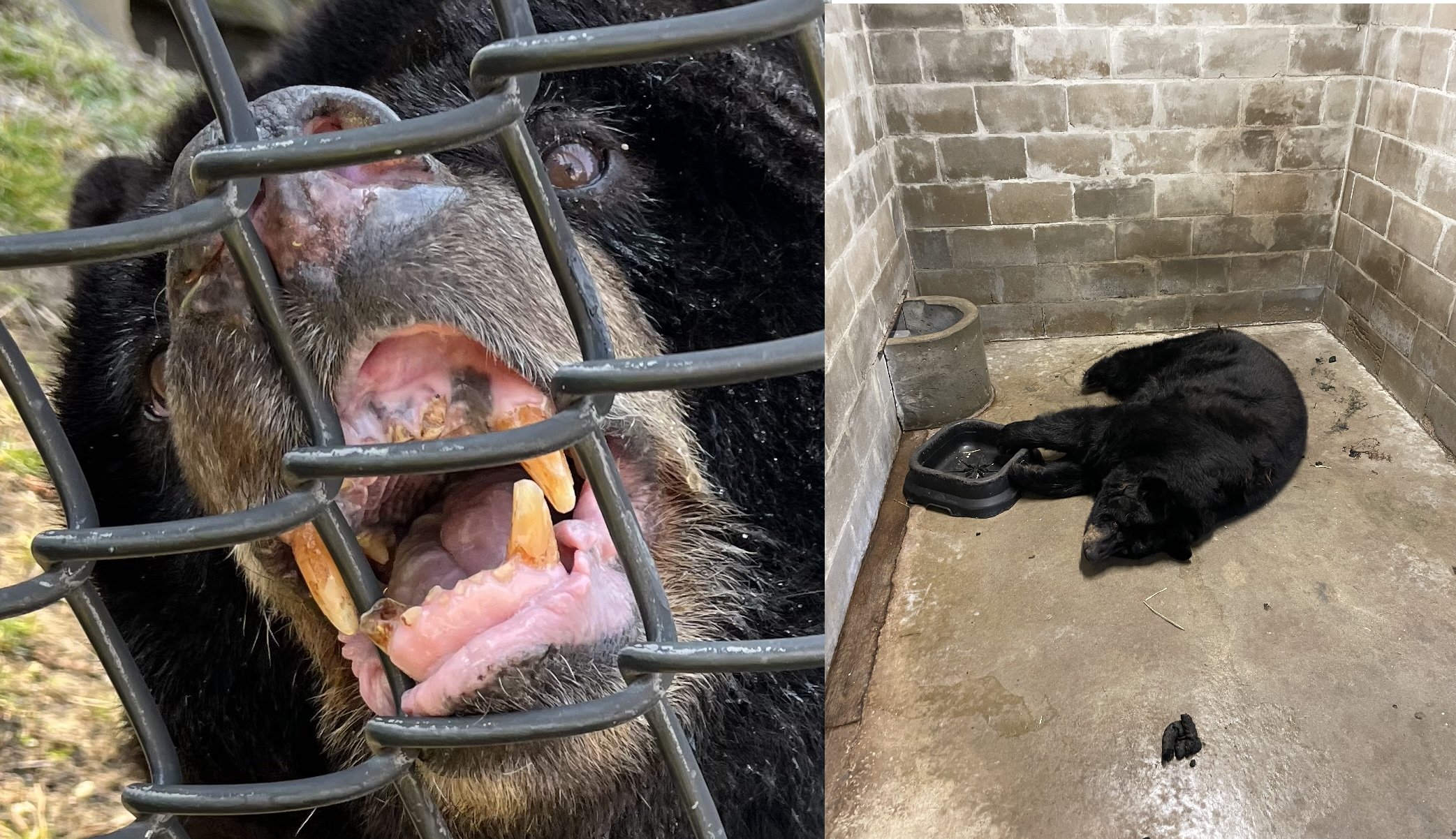
Before her death, the Holtsville Ecology Site confined Honey to a tiny, barren enclosure, where she reportedly suffered from broken and rotted teeth, chronic urinary tract infections, and displayed signs of severe stress, such as swaying back and forth. Other sick and neglected animals who allegedly recently died at the facility include a goat with a large abscess on his neck, a skunk suffering from cancer, a crow infected with West Nile Virus, and at least half a dozen parakeets who froze to death. Now, more than a dozen former employees of the Holtsville Ecology Site and the Town of Brookhaven are speaking out.

Who was Honey the bear?
More than a dozen former Holtsville employees allege that over the next two decades Honey endured a lifetime of relentless boredom and deprivation, suffering from broken and rotted teeth without dental exams, chronic urinary tract infections, obesity after being hand-fed by the public and given daily doses of unnatural marshmallow fluff, and succumbing to such psychological neglect that she paced and swayed—symptoms of brain damage according to neuroscientists specializing in large mammals in captivity—while Holtsville staff dismissed these behaviors as “dancing” to the public and consulted with a dog and cat vet over the phone.

Honey swayed and paced back and forth.
Honey succumbed to such psychological neglect at the Holtsville Ecology Site that she paced and swayed—symptoms of brain damage according to neuroscientists specializing in large mammals in captivity.

Zoom in for a close look at Honey’s broken and rotted teeth.
According to former Holtsville employees, she never underwent a dental exam.

Honey spent much of her life in solitary confinement in a concrete cell.
When Honey wasn’t swaying or pacing in front of the concerned public, she was locked in a concrete cell for up to 48 hours at a time—surrounded by her own urine and feces.

Apparent infection in Honey’s urine
Former employees allege that Honey suffered from chronic urinary tract infections treated with expired antibiotics prescribed to mustangs at the facility.

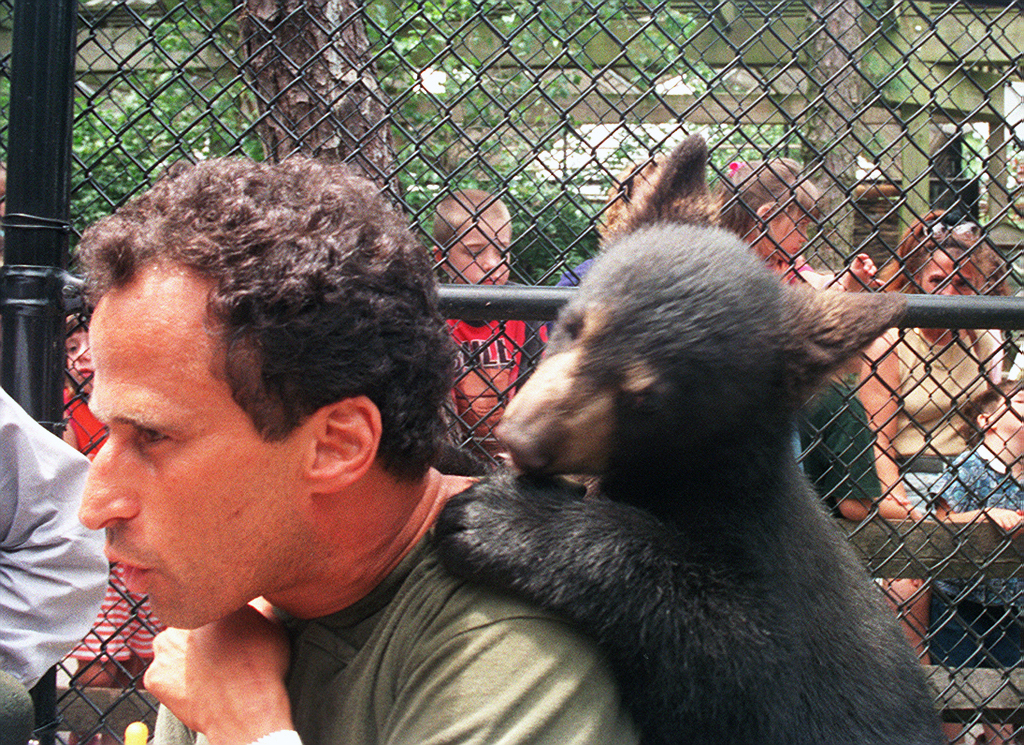
News coverage credits Larry Wallach (pictured) with donating Honey and Pooh to the Ecology Site.
Bobby Zigman, a former friend of Larry Wallach, told Humane Long Island that he witnessed Wallach repeatedly kicking Honey after she bit Zigman on his posterior in Wallach’s former East Rockaway home. Zigman says Wallach bought Honey in Ohio and used her for cub photo ops at fairs in New York, New Jersey, and Florida until she became too big to be used for this purpose before dumping her at the Ecology Site which has been telling the public a fabricated story ever since. (Greg Drossel of the LI Game Farm, which was recently cited for starving a giraffe to death, is also pictured.)

Notorious exhibitor Larry Wallach proudly shares a business card showing him as a former director of the Holtsville Zoo
The Share the Care Foundation helped manage the Holtsville Ecology Site in its early days.
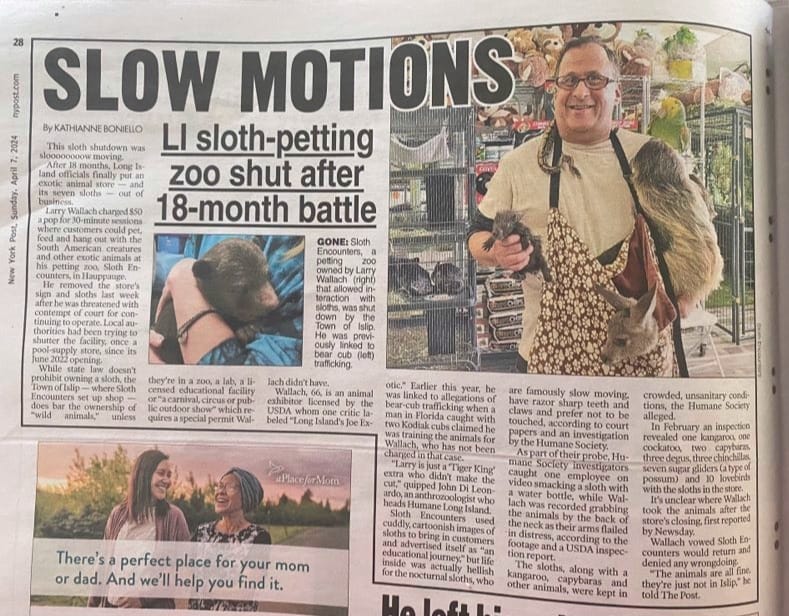
Who is former Holtsville Zoo director Larry Wallach?
Sloth Encounters’ owner Larry Wallach has been cited for more than sixty violations of the Animal Welfare Act, including “critical” violations related to lying to federal inspectors about the bite of a child and after an investigation revealed staff hitting sloths and Wallach roughly grabbing a wounded sloth by his head and neck. In 2023, Wallach pleaded guilty to unlawfully trafficking dangerous Nile monitors and was found in civil contempt of court. In 2024, Wallach was charged with criminal contempt and his unlawfully operated Hauppauge facility was shuttered by the Supreme Court. The USDA canceled Wallach’s license to exhibit animals the same year, but he has since fled to Florida where he is continuing to exhibit unlawfully.

Honey being handfed by a member of the public
Handfeeding bears is not only incredibly dangerous and irresponsible, but likely contributed to Honey’s obesity which exacerbated her painful arthritis.
Humane Long Island and several former and then-current Holtsville Ecology Site employees met with Brookhaven’s Highway Department about the alleged neglect of Honey and other animals after productive meetings with Brookhaven Supervisor Panico and Council Member Jonathan Kornreich, urging Highway Superintendent Dan Losquadro to allow a large animal veterinarian to examine Honey and transport her to PAWS Ark 2000—a 2,000-acre Global Federation of Animal Sanctuaries (GFAS)-accredited sanctuary home to lions, tigers, and bears with an exotic veterinarian on staff. Losquadro did not show up to the meeting and his subordinates refused to look at photographs of Honey’s broken teeth and concrete cell while Holtsville Ecology Site foreman April Perry said the department would not part with the animals no matter how much better their prospective homes could be.
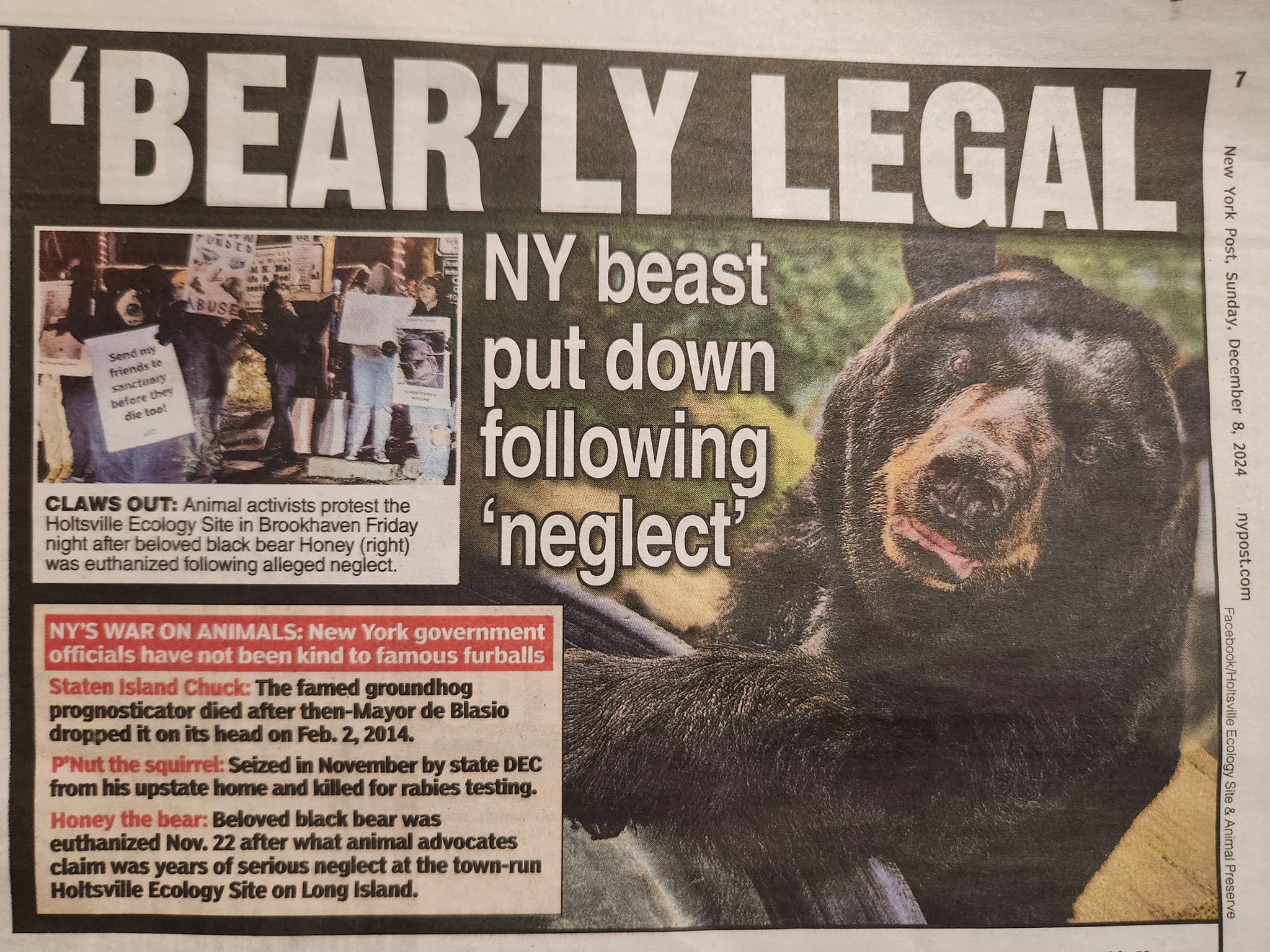
Honey was reportedly “euthanized” in December 2024, just 3 months after Humane Long Island urged the Town to have her evaluated by a large animal veterinarian and moved to a Global Federation of Animal Sanctuaries accredited facility. Her death came only 3 weeks after Humane Long Island met with the Brookhaven Highway Department and was told that Honey was “fine” and didn’t need to be evaluated by a large animal veterinarian. The timing of her death, the mystery of its circumstances—first being reported as a natural death and then later as euthanasia—and the rapid “euthanasia” of several other animals brought to the attention of town officials at this meeting, is troublesome and what forced Humane Long Island to make these conversations public with explosive independent investigations by Newsday and The New York Post after 3 months of private negotiations.
Nessy: A snapshot of Animal Care at Holtsville

On January 31, 2024, a Pekin duck residing at the Holtsville Ecology Site began exhibiting alarming neurological symptoms, being found upside down in her enclosure and suffering from lameness. Upon discovery, Nessy was removed from her enclosure and put in a small dog crate surrounded by supplies. Despite the urgent nature of the situation, head Animal Preserve Caretakers claimed that a veterinarian would not be available to examine her for almost a week. In response, a part-time staff member-turned-whistleblower transported Nessy to Evelyn Alexander Wildlife Rescue Center (EAWRC) in Hampton Bays for immediate treatment. Upon intake, Nessy presented with severe pododermatitis (a staph infection colloquially known as bumblefoot) in both feet, osteomyelitis (bone infection) in her left shoulder, major fractures to her right wing, poor bone density, an internal parasite load, and a lead level of 3.4ug/dL, showing lead poisoning. X-rays taken confirmed palpable findings. Due to the severity of the break, it was recommended that Nessy’s right wing be amputated as surgical repair was not feasible due to her compromised bone density. Furthermore, the wing could not be wrapped for stabilization due to the extent of the bone disconnection.
EAWRC’s supervisor notified staff at the Holtsville Ecology Site of these findings, however, the Ecology Site declined further treatment and promptly returned Nessy to the facility. Proper treatment would have consisted of multiple rounds of medication to eliminate lead from her system, weeks of antibiotics for her infections, and long-term pain management—care that Nessy did not receive at the Holtsville Ecology Site.
Rose Lynch, an Animal Care Assistant and New York State-Licensed Wildlife Rehabilitator at EAWRC told Town of Brookhaven board members that “Throughout this process, it was made abundantly clear that the Holtsville Ecology Site wanted to work against medical advice.“

X-ray showing untreated osteomyelitis (bone infection) in left shoulder (red circle) and a major untreated fracture to right wing (blue circle).

X-ray showing closer look at severe, untreated fracture to right wing.

X-ray showing osteomyelitis (bone infection) resulting from untreated pomodermitis (staph infection) in one of Nessy’s feet.

Pomodermitis (staph infection commonly referred to as bumblefoot)

Pomodermitis (staph infection commonly referred to as bumblefoot) in other foot
Nessy’s condition was unfortunately not isolated, providing a clear snapshot of the ailments many of the animals at the Holtsville Ecology Site were suffering from. Nessy’s poor bone density is indicative of inadequate nutrition, and her parasite load means all of the birds at the Ecology Site were likely infested with them—posing a danger to children as well as the animals. Bumblefoot is an easily preventable and treatable husbandry issue affecting nearly every waterfowl at the Ecology Site, yet no corrective measures have been taken to prevent it. The refusal to follow medical advice, particularly regarding the serious issue of lead poisoning is extremely troublesome. If the water at the Ecology Site is contaminated, every animal residing there was at risk of lead poisoning. Despite EAWRC offering to test the Preserve’s other waterfowl for lead poisoning, the Holtsville Ecology Site refused.
At the November 23, 2025, Town of Brookhaven public meeting, Supervisor Dan Panico publicly confirmed the unsafe conditions at the site, stating: “That [the Holtsville Ecology Site] is an uncapped landfill. The water that goes through the ground, and there’s garbage underneath there, percolates through and has caused a lot of the problems with Mott’s Pond, which is to the south. Those of you who look how the effect of the heavy metals and the work that we have to do, and have done, with the DEC (Department of Environmental Conservation) because of that. That is a fact.”
Feline Suffering at the Ecology Site
Leo the lynx
In 2022, a Eurasian lynx escaped their unlawful confinement in a Central Islip apartment complex and was captured after a week on the lam. Before he was even captured, several Big Cat Sanctuary Alliance and Global Federation of Animal Sanctuary-accredited sanctuaries—including The Wildcat Sanctuary, Carolina Tiger Rescue, and Turpentine Creek Wildlife Refuge—offered him a spacious, specialized home; however, the Holtsville Ecology Site circumvented this happy ending by sticking him in a small concrete pen where he paced back and forth.
According to former employees, the Ecology Site was ill-prepared to accommodate Leo and shortly after his arrival, he had zero access to water in the small indoor area he’s locked up in at night and on weekends during the winter months. Management apparently claimed they were unable to hook up a heated water dish, so said Leo would just have to cope without water. An employee-turned-whistleblower did not accept this and rigged up a heated dish using a PVC pipe to cover the wire, so Leo was able to have access to water over the weekends during the winter, and overnight.
According to this whistleblower, management went into Leo’s enclosure regularly to give him “high fives”—despite him still having claws—and made other employees take pictures of her interacting with him. Management relied on a wooden rod with a metal hook taped to the end that someone would hypothetically use to beat him off with in the event something went wrong. When told by Harry Timmerman, the General Foreman, that AZA zoos don’t go in direct contact with big cats due to safety, head Animal Preserve Caretaker Kristin Layer reportedly claimed it was okay because “the Ecology Site isn’t AZA accredited.”
Surabi the bobcat
Surabi was a bobcat who inhabited Leo’s current exhibit for 15 years before being moved into a much smaller and more barren enclosure upon his arrival. Because of this, Surabi was incredibly stressed and rarely left her indoor area—described by former employees as a small “cave-like” area that is rarely cleaned, reeked of cat urine and feces, and is dark and filled with spider crickets. Despite being stressed by public viewing, Surabi was frequently locked out of her indoor area and forced to be on exhibit. Like Leo previously, Surabi was reportedly not provided with a heated water dish in her outdoor enclosure during the winter months; thus, if her water froze and she was locked into public view, she was apparently without access to water.
What Leo’s life could have been
Sox & Sixx
Wild cats weren’t the only cats who suffered at the Holtsville Ecology Site.
A domestic cat named Sox lived tethered to a hedgehog cage by a short leash inside a dusty warehouse for at least 8 hours per day. According to former employees of the Holtsville Ecology Site, Sox’s food and water dish was surrounded by perpetual debris, and he suffered from unmanaged respiratory distress—likely related to his filthy environment. Being a predator tethered to a prey animal’s cage was stressful for both him and the hedgehog named Valentine.
In addition to Sox’s undiagnosed respiratory issues, Sox suffers from allegedly mismanaged diabetes. Since giving him the proper treatment would require administering insulin outside of normal office hours, he apparently did not receive his medication on an appropriate schedule. Employees additionally alleged that head Animal Preserve Caretaker Kristin Layer insisted on administering insulin directly into Sox’s vein instead of administering it subcutaneously as prescribed. Sox was reportedly often heard crying out in pain because of this malpractice.
Sox was perpetually filthy. and his constant tethering causes fur loss and matting. Former employees allege that Sox also suffers from apparent skin infections due to the filthy conditions.
Sixx—a senior cat who lived in a dirty barn—suffered from chronic, putrid abscesses, and untreated, infected wounds from fights with feral cats and raccoons. In 2024, Sixx was locked in a dog crate for more than two weeks after he suffered multiple infected abscesses to his face and head. According to employees, head Animal Preserve Caretaker Kristin Layer continuously picked at Sixx’s wounds and scabs with uncovered hands, causing prolonged complications with healing.


improper housing & Handling
Deaths due to Exposure & Drowning
Shelter at the Holtsville Ecology Site was a privilege that not all animals enjoyed. During the winter of 2024, two parakeets died of exposure during frigid temperatures overnight. Four other parakeets died previously while living in an unprotected, unheated, and partially outdoor enclosure next to Betty the Pine Marten during the winter of 2023. Stress from being kept in constant view of a predator may have been an exacerbating factor. A seventh parakeet died in 2024 after suffering severe nerve damage to her wing.
Larry was a rooster who died in February 2023 after Animal Preserve Caretakers Layer and Stein reportedly cut all of the roosters’ spurs during a snowstorm. The next morning, Larry was found frozen in their only shelter (a plastic dog crate filled with straw) with blood pooled around him.
Birds weren’t the only animals to die during frigid winters. According to former Brookhaven public safety officer Meredith Tinsley who patrolled the Ecology Site, a mountain lion drowned in their enclosure one night after becoming trapped underneath the ice. Tinsley said staffers were told by bosses, including Holtsville Ecology Site foreman April Perry, “Don’t tell anybody, because we’ll never get another mountain lion.” The lion’s enclosure wasn’t cleaned before its replacement was ushered in, she added—a protocol that Tinsley claims was customary. Then their replacement wasn’t eating, so they were fed anti-anxiety meds, said Tinsley.


Animal Escapes & Coverups
Animals known to have escaped from Holtsville Ecology Site include a fox named Hunter who badly bit head Animal Preserve Caretaker Kristin Layer in 2022 (this bite went unreported) before dying from alleged medical neglect in 2023 and a pine marten who escaped from a damaged door into the park’s sewer in 2023. A wolf-hybrid went missing and was never recovered in 2018 and two mustangs were found outside their enclosure shortly thereafter.
Tinsley said that when the zoo couldn’t locate an eagle in its care she was told, “Don’t say anything to anybody, we can’t let anybody know we lost the eagle.” She said she was frequently told by some higher-ups that if missing animals were reported to authorities or up the work chain, “We won’t get any funding … We just have to wait until we get the funding.”

Unlicensed Surgeries
Staph infections were a recurring problem amongst all of the poultry at the Holtsville Ecology Site—likely due to a combination of poor nutrition, filthy conditions, and concrete substrate. These conditions were exacerbated by unnecessary surgeries performed by unlicensed, untrained staff without the use of antiseptic, sedation, painkillers, or antibiotics. Similar surgeries have been performed on goats, removing pieces of injured horns with scissors and lancing abscesses without sterilizing equipment. Holtsville Ecology Site did not have a farrier regularly maintaining the hooves of resident animals. Instead, head Animal Preserve Caretaker Kristin Layer—who is not a farrier—had reportedly taken this upon herself, resulting in permanent disability to a goat named Cleo.

Head Animal Preserve Caretaker Kristin Layer is photographed performing an unlicensed surgery on a duck.
Layer is not a veterinarian.

Stefan the rooster bleeding from an unlicensed surgery
Staph infection is properly treated with antibiotics, but at Holtsville Ecology Site, birds like Stefan are routinely cut into by untrained, unlicensed staff without the use of painkillers, antiseptic, or antibiotics.

Head Animal Preserve Caretaker Kristin Layer cut a chunk of flesh out of Stefan’s foot.
Stefan is confined year-round on concrete. As a result, he has endured chronic bumblefoot for several years, causing significant pain and impairing his mobility. Instead of addressing the underlying cause – unsuitable, wet, and unsanitary flooring – the zoo’s head animal caretaker, Kristin Layer, insists that the infection must be “cut out,” which simply opens the body to further infection. On multiple occasions, Layer instructed a part-time staff member to restrain Stefan while she incised his infected foot with a scalpel, without administering any sedation, anesthesia, or pain relief.

Staff severed Salt’s broken horn with a scissor.
Salt and Pepper are two goats who are housed with the cows because of their fear of humans. They are confined together during feeding time and fight with each other over limited grain, resulting in injuries such as this.

Another view of Salt’s horn
According to former employees, staff severed the broken horn with a scissor, without painkillers or antiseptic.

Snickers died following the appearance of this abscess
Snickers had a large abscess on his neck which was left untreated for weeks. Management was witnessed ripping hair around the wound and attempts were made to lance it without pain meds or anesthetic. When Snickers eventually started a treatment plan, no diagnostics were performed to test for a malignancy. Snickers began coughing and wheezing before he died.

Cleo’s hoof grows deformed following improper trimming
This has resulted in permanent and painful disability.
Click the video below for More
📣Hear from the whistleblowers
Cayleigh Kunnmann worked as an animal caretaker at the Holtsville Ecology Site from June 2022 until August 2024.
She told Newsday: “There are so many animals living in conditions that are just abysmal.” When she and other workers raised concerns with the senior staff about animals’ declining health or filthy enclosures, she said, “a lot of the time you really get brushed off.”
Kunnmann told CBS New York: “I worked here over two years, and there is a feeling of despair when you come here every day … Honey was the most chronically stressed animal I’ve ever seen in my life. She consistently swayed back and forth.”
Kathleen Connolly worked as an animal caretaker at the Holtsville Ecology Site until late 2024.
She told CBS New York: “There is just very blatant medical neglect here … I’ve seen staff take medical concerns into their own hands when they have no training or education.”
She told Newsday: “Rabbits and other small animals would be living in piles of their own feces for days.”
Sarah Winter worked as animal caretaker at Holtsville Ecology Site until just before Honey’s December 2024 death.
She told Newsday: “Honey had suffered for years without pain medication from arthritis, chronic urinary tract infections and cracked and rotten teeth … By day she would often retreat to a corner of the pen … where she was partially hidden from the crowds. She often swayed from side to side, a neurotic behavior that experts say develops when captive animals are stressed. At night she was ushered into a barren concrete stall.”
Emma Sanwald worked as a full-time Animal Preserve Caretaker at the Holtsville Ecology Site for two years.
On October 23, 2025, she told the Brookhaven Town Board: “I cannot stress enough the abysmal conditions of the park, the outdated husbandry of the animals, and the lack of understanding or empathy for those animals that reside there … I cannot stress enough the importance of understanding what these animals have gone through. Holtsville is not an active wildlife rehabilitation center, they are not improving or stewarding the environment in any beneficial manner, and they certainly are not educating the youth or the community on wildlife or any form of environmental conservation.
Victoria, the bald eagle with a TBI, is terrified of guests and caretakers alike. Her main nesting area has never been cleaned, and she cowers into it all summer in an attempt to hide from the loud, busy parking lot directly behind her enclosure. Nessy, a Pekin duck, had a debilitating old and untreated wing fracture, a bone infection, horrific and painful sores on her feet, and probably most concerning, lead poisoning from being at the Ecology Site. A park built on a retired landfill, with lead infecting the animals and garbage moving up the soil into their pens, was never supposed to be built in the first place.
I urge the residents of Brookhaven to look past their nostalgia; view these animals with the respect they deserve; they’ve been through enough. These animals deserve a chance to live their lives out in peace, with grass under their feet, professional veterinary care, clean water, appropriate diets, and more than just bare minimum enclosures. Long Island has hundreds of other parks to choose from, with rich and diverse wildlife and stunning hiking trails. Please do the right thing for these animals. A highway department has no business running a zoo.”
Dylan Ryan worked as an Animal Preserve Caretaker at the Holtsville Ecology Site for a year and a half.
In March 2025, she told the Brookhaven Town Board: “During my time at the Holtsville Ecology Site, it became overwhelmingly clear that every animal residing at the Zoo was severely mistreated and neglected. I witnessed countless animals I had grown close to and loved deeply wither away and die due to willful neglect and mismanagement. No access to veterinary care, improper diets, untreated injuries and illnesses. Despite raising concerns to management, nothing ever changed.
In 2023, I finally left my position. I was torn about leaving the animals behind, but I made a promise to them and to myself. That’s why you are hearing from me today.
The Holtsville Ecology Site is not accredited by the Association of Zoos & Aquariums, has never applied for accreditation, and does not uphold the Association’s standards of animal care. In fact, both Holtsville Ecology Site foreman April Perry and senior Animal Preserve Caretaker Kristin Layer have violated the Association’s standards, participating in direct contact with big cats. Kristin Layer has entered the Preserve’s Eurasian Lynx enclosure several times, taking photos and boasting to others about it. No reputable zoo would ever allow this. In fact, it can cost a facility its accreditation.”
Kaitlyn Lombardi worked as a former Animal Preserve Caretaker at the Holtsville Ecology Site for only a few days before she put in her two weeks’ notice after witnessing animals stuffed into “cramped, deteriorating enclosures.”
At a February 2025 Brookhaven Town Board Meeting, Kaitlyn told the Town Board that “Staff members seemed to rationalize the conditions, and nobody seemed to care about addressing the issues.” She also alleged that some animals were often left unfed.
Meredith Tinsley, a former longtime Brookhaven officer whose duties included patrolling the Holtsville Wildlife & Ecology Center, told The New York Post of stomach-churning animal neglect—as well allegations of a cover-up.
“It is the general consensus to lie, to defraud, to pretend like nothing is happening,” Tinsley, 55, said of the troubled refuge, which has been managed by the town of Brookhaven’s highway department since it opened in the 1970s.
Tinsley testified at an explosive Brookhaven town board meeting, along with several ex-staffers of the facility, which has come under fire over allegations of woefully inadequate veterinary care and deadly animal neglect. The group leveled hair-raising allegations ranging from animals dying from exposure to unauthorized staff cutting into the creatures with razor blades—resulting, at times, in permanent disabilities.
When the zoo couldn’t locate an eagle in its care, “I was told, ‘Don’t say anything to anybody, we can’t let anybody know we lost the eagle,’” Tinsley said at the meeting. “I called 911. I reported it.”
She said she was frequently told by some higher-ups that if missing animals were reported to authorities or up the work chain, “We won’t get any funding … We just have to wait until we get the funding.”
A mountain lion also drowned in its enclosure one night—and Tinsley said staffers were told by bosses, including Holtsville Ecology Site foreman April Perry, ‘Don’t tell anybody, because we’ll never get another mountain lion.’ The lion’s enclosure wasn’t cleaned before their replacement was ushered in, she added—a protocol that Tinsley claims was customary. Then their replacement wasn’t eating, so they were fed anti-anxiety meds.
Jessica Chiarello is the Head of Hospital at a local wildlife hospital and a New York State-Licensed Wildlife Rehabilitator.
Chiarello—who treated the Ecology Site’s Pekin duck Nessy for fractures, infections, and lead poisoning—has rehabilitated and released “many hundreds” of wild animals over the past seven years at Evelyn Alexander, and told Newsday that some of the animals at Holtsville could be candidates for release, including the pine marten, the woodchuck, and several of the birds of prey who appear to fly well. “It’s a big decision whether you’re going to keep these animals in a cage for the rest of their lives.”
Rose Lynch, a staffer at a local animal hospital that treated the Ecology Site’s Pekin duck Nessy for lead poisoning, told the Brookhaven Town Board it was “heartbreaking that [the bird’s] injuries had become so severe, especially in human care … Throughout this process, it was made abundantly clear that the Holtsville Ecology Site wanted to work against medical advice … and categorically refus[ed] to get any of their other waterfowl tested for lead poisoning.”
Independent Media investigations
Newsday, The New York Post, and The Long Island Advance, 1010 Wins, CBS, and more independently interviewed former employees of the Holtsville Ecology Site and were given access to more than a hundred pages of documentation compiled by these former employees. Newsday and The Long Island Advance subsequently authored editorials in support of moving the animals to sanctuaries while outlets like The New York Post published numerous exposés.
Allegations of animal neglect at Holtsville Ecology Site – Newsday
Long Island ecology center accused of animal neglect by former employees – CBS New York
LI animal refuge accused of neglecting beloved bear before euthanizing it – New York Post


Frequently asked questions
What happened to the animals when holtsville ecology site closed?
Humane Long Island offered to arrange placement for all of the Holtsville Ecology Site animals—at no cost to taxpayers—at reputable sanctuaries where they could receive specialized care and live in environments better suited to their physical and behavioral needs. We prioritized facilities accredited by the Global Federation of Animal Sanctuaries (GFAS) and members of the Big Cat Sanctuary Alliance. Unfortunately, the Town declined our proposal.
Instead, many of the animals were transferred to Association of Zoos and Aquariums (AZA)-accredited zoos, including the Bronx Zoo. While these facilities generally offer higher standards of care than the conditions the animals endured at a municipal roadside zoo, they still keep and breed wild animals into lifetimes of captivity primarily for exhibition purposes rather than providing true sanctuary.
The llama and alpaca were transferred to Long Island Yarn & Farm, where they will continue to be used for fiber production and public entertainment. One arctic fox was fortunate enough to be transferred to Arctic Fox Daily Wildlife Rescue & Sanctuary—a placement Humane Long Island had recommended and supported. Tragically, another arctic fox died under unclear circumstances in 2025 during our campaign to close the facility and relocate its remaining animals.
Although some of the animals were sent to facilities with improved resources, the closure of the Holtsville Ecology Site represented a missed opportunity to provide all of its animal residents with permanent sanctuary placement, free from exhibition and exploitation.
Why couldn't the holtsville ecology site be improved?
In 1979, Brookhaven Town’s Holtsville Ecology Site opened on what was once a New York State owned landfill. Decades later, the consequences of building on such a site are still evident—from toxic runoff contaminating nearby ponds to debris such as broken glass and plastics surfacing within animal enclosures. 🗑️
At the November 23, 2025, Town of Brookhaven public meeting, Supervisor Dan Panico publicly confirmed the unsafe conditions at the site, stating: “That [the Holtsville Ecology Site] is an uncapped landfill. The water that goes through the ground, and there’s garbage underneath there, percolates through and has caused a lot of the problems with Mott’s Pond, which is to the south. Those of you who look how the effect of the heavy metals and the work that we have to do, and have done, with the DEC (Department of Environmental Conservation) because of that. That is a fact.”
Evidence of contamination was already shown in the winter of 2024, when Nessy, a Pekin duck residing at the Ecology Site, was brought to the Evelyn Alexander Wildlife Rescue Center (EAWRC) with a blood lead level of 3.4 µg/dL, indicating lead poisoning. Despite notification from EAWRC’s Supervisor, Holtsville staff declined further treatment and promptly returned Nessy to the facility—against medical advice. Proper treatment would have required multiple rounds of medication to remove the lead from her system. Rose Lynch, an employee at EAWRC, later told the Brookhaven Town Board, “Throughout this process, it was made abundantly clear that the Holtsville Ecology Site wanted to work against medical advice.” Given the contamination of the Ecology Site’s water, all animals residing there may be at risk of lead poisoning. Although EAWRC offered to test the remaining waterfowl, the Ecology Site refused.
The dangers were not limited to water contamination. Debris surfacing from the ground has created hazardous living conditions for the animals. Wilbur, a deceased pig, lived in an enclosure often littered with sharp and unsafe materials. In the summer of 2022, he sustained a deep puncture wound behind his ear—likely the result of this hazardous environment. Despite the injury, no corrective measures were taken to prevent future harm.
What does the Town plan to do with the site?
Supervisor Panico has confirmed that the closure of the Holtsville Ecology Site—which will save taxpayers $2 million annually—only includes relocation of the animals and will not impact the surrounding trails, greenhouses, parks, compost, pools, or picnic areas. The Town plans to use the site to expand its offerings of community amenities, with the idea of a possible splash park being added to the site. The area will remain for public use and will not be offered for private development.
Weren't the animals at Holtsville Ecology Site rescues?
Revelations about the sordid origins of many of the animals at the Holtsville Ecology Site, including bears Honey and Pooh being dumped there in partnership with Sloth Encounters owner Larry Wallach after being allegedly bought at auction and used for cub petting encounters (along with the miniature horses), has raised questions about the authenticity of many of the origin stories of animals at the Holtsville Ecology Site. Other animals, including Lucy the Bison and several of the goats, were bred into a lifetime of confinement at the landfill.
Who was trying to keep it open?
Disgruntled employees, like senior Animal Preserve Caretaker Kristin Layer—who was exposed for allegedly performing surgeries on animals at the Ecology Site without training, licensure, antiseptics, or antibiotics—spread misinformation about the Town’s plans in a last-ditch effort to save their jobs, despite the Town promising to keep them hired in other capacities more suited for highway department employees. They were supported by notorious animal exhibitors—including big cat exhibitor Felicia Frisco whose uncle is on video beating and electroshocking elephants.
Other employees of the Town of Brookhaven Highway Department were documented sexually harassing and intimidating their former colleagues who spoke out against mistreatment of animals at the Ecology Site; meanwhile, our friends at Evelyn Alexander Wildlife Rescue Center—the East End’s only wildlife hospital—were maligned for speaking up after treating a duck named Nessy who suffered staph infection, osteomyelitis (bone infection), broken bones, parasites, and lead poisoning at the former landfill.
All of this was for nought, as the Site has now closed.
Where can I bring my kids to visit animals humanely?
There’s nothing like watching animals where they truly live—in their natural habitats, following their instincts, shaping ecosystems, and playing their role in nature’s balance. Visiting animals in the wild supports conservation-based tourism and local communities that protect these environments, rather than funding cages or displays that can’t replicate freedom. When you experience wildlife responsibly—through guided safaris, birding trips, or national park visits — you’re not just observing nature, you’re helping preserve it.
Our favorite places to visit animals on Long Island are Wertheim National Wildlife Refuge, located in Shirley; Evelyn Alexander Wildlife Rescue Center, located in Hampton Bays; and Critterville Farm Sanctuary, located in Riverhead. You can also contact us at John@humaneli.org to schedule a visit to our Riverhead sanctuary where we rescue and rehabilitate farmed and exotic animals rescued from Manhattan to Montauk.
What humane long island is doing to help
-
Humane Education
Humane education teaches empathy, respect, and care for animals as sentient beings—not as exhibits. While zoo visits can appear exciting, they often present animals in unnatural enclosures, limiting their freedom and failing to show their natural behaviors.
Observing animals in captivity can unintentionally convey the message that it’s acceptable to confine animals for human entertainment and studies show that seeing endangered animals in unnatural settings undermines legitimate conservation efforts by misleading people into thinking that wild populations are not imperiled, making them less likely to donate to conservation. Humane education, by contrast, focuses on understanding animals’ needs, respecting their well-being, and learning how to make compassionate choices.
Instead of zoo visits, Humane Long Island offers sanctuary field trips, virtual animal visits, and classroom programs for students, families, scouts, and people with special needs that provide authentic, stress-free experiences where kids can truly connect with animals and learn kindness in action.

-
Lobbying to restrict traveling wild animal acts and close loopholes in State Law pertaining to exotic “Pets”
Humane Long Island doesn’t just rescue exotic animals. We advocate to stop them from needing our help in the first place!
Long before we exposed animal mistreatment at the Holtsville Ecology Site, we successfully lobbied to stop monkeys from being chained to dogs at the Brookhaven Fair and played a critical role in Ringling Bros. and Barnum & Bailey Circus going animal-free!
-
We recently worked with lawmakers to restrict traveling exotic animal acts across Suffolk County. We’re now working with Senator Monica Martinez and Assembly Member Linda Rosenthal on legislation to ban the sale of certain exotic animals—including sloths, kangaroos, and capybaras—to the public.
Supporting reputable wildlife sanctuaries & Rehabilitators
There’s nothing like watching animals where they truly live—in their natural habitats, following their instincts, shaping ecosystems, and playing their role in nature’s balance. Visiting animals in the wild supports conservation-based tourism and local communities that protect these environments, rather than funding cages or displays that can’t replicate freedom. When you experience wildlife responsibly—through guided safaris, birding trips, or national park visits — you’re not just observing nature, you’re helping preserve it.
Our favorite places to visit animals on Long Island are Wertheim National Wildlife Refuge, located in Shirley; Evelyn Alexander Wildlife Rescue Center, located in Hampton Bays; and Critterville Farm Sanctuary, located in Riverhead. You can also contact us at John@humaneli.org to schedule a visit to our Riverhead sanctuary where we do rehabilitation.
Humane Long Island has provided tens of thousands of dollars in improvements at sanctuaries around the country and is currently lobbying to redirect $1.4 million being misused by the DEC’s New York State Conservation Fund to stock non-native pheasants for canned pheasant hunting toward reputable wildlife rehabilitation.