

Wildlife roundups
Culls” is a cold, sanitized word for what is nothing less than mass slaughter. In 2021 alone, USDA APHIS Wildlife Services—dubbed “Agriculture’s Misnamed Agency” by the New York Times—wasted $124 million of taxpayer money to kill 1.76 million animals. Among the victims were 400,000 native species, countless household pets, and at least 3,000 animals killed by mistake. Private exterminators added to the carnage, leaving an uncountable trail of suffering—all in the name of protecting corporate interests and hunting profits.
Duck, Blame, and Cover: How Humanity Scape-Gooses Nature
The largest threats to environmental health—stormwater runoff, agricultural chemicals, industrial discharges, and sprawling development—often far outweigh any impact from wildlife. Yet animals like Canada geese, wild turkeys, and white-tailed deer—modern-day survivors of deep evolutionary lineages—are frequently portrayed as ecological nuisances. Canada geese and wild turkeys, both descended from theropods such as Tyrannosaurus rex and Velociraptor, and deer, whose ancestors once roamed alongside mammoths and saber-toothed cats, are not invaders but long-standing members of North America’s ecological community, with roles that predate human settlement by millions of years.
For thousands of years, Native Americans coexisted with these species in balance, but egg harvesting, overhunting, and widespread destruction of forests and wetlands during European colonization caused massive declines. By the early 1900s, Canada geese, wild turkeys, and white-tailed deer—once abundant—were approaching regional extinction, victims not of natural imbalance but of human expansion and exploitation.
The federal Migratory Bird Treaty Act of 1918 offered a lifeline to waterfowl like the Canada goose, providing legal protection and spurring the creation of wildlife refuges. Similarly, mid-20th-century conservation efforts reintroduced wild turkeys and restored white-tailed deer populations across the United States. Ironically, these recoveries are now so successful that the very species once nearly eradicated are blamed for “overpopulating” suburban lawns, golf courses, and parks—the same manicured, human-designed habitats that replaced their natural ecosystems.
Canada geese, adaptable and intelligent, capitalized on human-created environments—open grassy fields, retention ponds, and artificial lakes—turning recreational spaces into nesting grounds. Deer discovered ample forage along road edges, suburban gardens, and fragmented forests. Wild turkeys, once creatures of deep woods, now strut along cul-de-sacs and corporate campuses, thriving in landscapes built for human convenience. Their resurgence is not an invasion but a mirror: a reflection of how profoundly we have reshaped the land.
So, while we grumble about “too many geese” fouling ponds or “too many deer” in our headlights, we overlook the true culprits—our roads, our sewage systems, our fertilizers, our monoculture lawns, and impermeable pavement. These are the real drivers of algae blooms, erosion, and habitat degradation. Blaming wildlife for the consequences of our excess is a comforting deflection—a kind of ecological scapegoating, or perhaps, scape-goosing.
In truth, the geese, the turkeys, and the deer are not the problem; they are survivors. They endure in spite of us, not because of us. To scape-goose them for anthropogenic ruin—to blame geese for algae blooms, turkeys for suburban trespass, and deer for nibbling gardens—is to punish resilience as if it were guilt, while humanity sidesteps the consequences of the roads we build, the fertilizers we spread, and the ecosystems we unravel.
USDA & NY DEC: The Hidden Enforcers of animal Agriculture and Hunting Interests
Behind the official facade of conservation, agencies like the USDA Wildlife Services (WS) and the New York State Department of Environmental Conservation (DEC) often act as enforcers for industrial agriculture and recreational hunting, fishing, and trapping interests. While these agencies claim to manage wildlife for public benefit, their actions frequently prioritize corporate profits and lobbying agendas over ecological health and animal welfare.
Wildlife Services: Hitmen for Animal Agriculture & Purveyors of taxpayer waste
The U.S. Department of Agriculture Animal & Plant Health Inspection Service (USDA APHIS)’s Wildlife Services division is tasked with managing conflicts with wild animals that allegedly threaten human health, livestock, or property. Yet, whether it’s deer in Southold or geese in Islip, Wildlife Services has historically relied on lethal measures at nearly every turn. In its early days, massive poisoning campaigns targeting predators waged a literal war on wildlife, the ecological consequences of which linger to this day. Modern Wildlife Services continues this legacy, killing millions annually—reflecting an entrenched culture that treats violence as the default solution to human-wildlife conflicts.
In 2021 alone, Wildlife Services spent $124 million in taxpayer dollars to slaughter 1.76 million animals. Of those, 400,000 were native species, some were even pets, and at least 3,000 were killed unintentionally. Countless others were eliminated by private contractors operating with the blessing of the U.S. Fish & Wildlife Service, a sister agency complicit in extending this lethal agenda.
NEw york DEC: The Local enforcer
The NY DEC frequently mirrors Wildlife Services’ (WS) priorities, implementing policies that favor industry and recreational lobbies:
-
Supporting hunting, fishing, and trapping regulations that maintain profitable wildlife populations rather than natural ecological balance.
-
Endorsing lethal wildlife control measures in urban and suburban areas under the guise of public safety to promote hunting opportunities.
-
Facilitating industrial agricultural interests through regulatory or technical assistance, sometimes directly contracting with agencies like WS for costly, ineffective, and endlessly repeating taxpayer-funded kill contracts.
The DEC presents hunting, fishing, and trapping licenses as supporting the NYS Conservation Fund, giving the impression of a conservation purpose, when in reality the Fund primarily subsidizes hunting, fishing, and trapping programs. It even allows money to be used to promote shooting (Section 83, State Finance Law), effectively humane-washing the killing of animals for recreation under the guise of conservation.
The Conservation Fund Advisory Board (CFAB), which advises the DEC on policies, plans, and programs affecting fish and wildlife—including how Conservation Fund money is spent—requires members to be longtime hunters, fishers, or trappers. Licensed wildlife rehabilitators are excluded, even though organizations like Humane Long Island and Evelyn Alexander Wildlife Rescue Center absorb far greater costs rescuing and treating animals harmed by hunting, fishing, and trapping than hunters contribute through their $22 licenses. When questioned, DEC leadership told Humane Long Island that rehabilitators are not considered stakeholders because they do not “pay into the Fund,” ignoring the immense public service and financial burden borne by those who actually care for wildlife harmed by these very same licensees.

Factory Farming pheasants for Canned Hunting: A case study
A striking example of the DEC’s misuse of NYS Conservation Fund dollars is its artificial pheasant propagation program.
Ringneck pheasants—Chinese birds bred on a state-sponsored factory farm using $1.4 million annually from the NYS Conservation Fund—are so helpless that the DEC promotes them for introducing youths and people with disabilities to hunting. The DEC openly admits the program exists “to provide pheasant hunting opportunity, not to restore wild populations.”
-
More than 90% of these baby birds are killed by predators, cars, or starvation.
-
Half die within the first week of release.
-
Hunters, conservationists, and wildlife officials call the practice “futile, inappropriate, and inhumane.”
-
Pheasants are non-native and cannot adapt to New York’s woodland or suburban environments.
-
Other states like Minnesota and South Dakota ended similar programs decades ago.
This program normalizes killing under the guise of conservation, tortures baby birds, endangers highways, and indoctrinates youths into canned trophy hunting. The link between animal abuse and violence toward humans is well-documented—New York should not be using “conservation” funds for this purpose.
Killing with Cloak & Cyanide
Lack of Transparency
In 2017, Humane Long Island was invited to speak before the Lake Ronkonkoma Advisory Board about Canada geese. Prior to our presentation, representatives from the New York State Department of Environmental Conservation (DEC) and USDA Wildlife Services proposed massacring 200 geese on the lake. Candidly acknowledging potential public backlash, they even suggested conducting the killing under cover of night and using fertility control ahead of the season—a tactic they argued would reduce the chance of the public catching them on camera. This came moments after the same representatives had told the board that fertility control “didn’t work,” claiming lethal removal was the only option.
If Humane LI hadn’t been present to call out these contradictions, hundreds of geese would have been killed, only to be replaced by a new flock the following year—continuing the same deadly cycle. Thankfully, the Advisory Board adopted our non-lethal recommendations instead.
While Humane Long Island has successfully prevented wildlife massacres across Long Island nearly every time we’ve intervened, state and federal agencies routinely circumvent accountability. For instance, when Humane LI filed a FOIL request in 2022 for records related to deer and geese kill contracts, the DEC denied the request in its entirety, citing: “POL 87.2.f. Could endanger the life or safety of any person if disclosed.”
Dodging ‘fair chase’, endangering public safety & KIlling pets
Violating Freedom of Information Law is only the tip of the iceberg in terms of state and federal agencies exempting themselves from the law. For example, the federal Migratory Bird Treaty Act (MBTA) protects migratory birds, including Canada geese, from being hunted during their molting season—when they are flightless and caring for their babies. Yet, this is precisely when the USDA schedules its Canada geese roundups.

On Long Island, Wildlife Services agents have routinely baited deer over several days to gain their trust, only to kill them under cover of night using silencers.
The agency’s cruelty extends far beyond prey animals. Wildlife Services is infamous for aerial gunning of wolves from helicopters and deploying M-44 cyanide devices, which release deadly sodium cyanide when triggered, to kill predators like coyotes. These devices are so indiscriminate and dangerous that the Bureau of Land Management banned their use on public lands in 2023 after a child was hospitalized and his dog, Kasey, was killed while triggering one just 400 feet from their home. Similarly, Wildlife Services’ use of Sodium Fluoroacetate (Compound 1080) is highly irresponsible due to its extreme toxicity, risk to non-target animals, environmental hazards, and human safety concerns.

Opportunity on the Hudson
On January 15, 2009, birds were blamed for bringing down the jetliner that “Sully” Sullenberger famously landed on the Hudson River. Since then, USDA Wildlife Services has seized the opportunity to kill more than 100,000 birds near—and, as you’ll see below, far from—New York airports.
Despite LaGuardia and Newark airports contracting with Wildlife Services to cull birds after the so-called “Miracle on the Hudson,” the number of recorded bird strikes at these airports has nearly doubled in the years that followed. The agency’s target list has expanded to include swans, blackbirds, crows, starlings, and even federally protected Snowy Owls.
In 2020, Wildlife Services’ recklessness led to the massacre of 86 geese and baby goslings at Milburn Pond Park, supposedly for “flight safety”—despite the park being more than 11 miles from the nearest airport. Following inquiries by the South Shore Audubon Society and a vigil by Humane Long Island, the agency admitted to rounding up the geese and their babies during their molting season—when the birds lose their flight feathers and are most helpless—and apologized for its “error.””
poisoning the underprivileged
Killing wildlife is a public relations nightmare, so officials often attempt to sanitize these massacres by announcing that the meat will be donated to low-income communities. This tactic, framed as “feeding the hungry,” is deeply patronizing and exposes a glaring contradiction: these animals are supposedly killed because they are starving, sickly, or disease-ridden—yet their flesh is somehow considered safe enough to serve to marginalized communities.
Legitimate hunger-relief organizations, including the NYC Coalition for the Homeless and Long Island’s Community Solidarity, have publicly rejected these carcass donations—in part, due to contamination risks. For example, after more than 700 geese were slaughtered at Jamaica Bay Wildlife Refuge, their meat was sent to a Westchester food bank with explicit warnings: the New York State Department of Health advised no more than two meals per month because the birds may have been exposed to environmental contaminants. Additionally, the meat carried a second warning: it could contain birdshot, the small lead pellets used in shotgun shells, posing a risk of chipped teeth or ingestion hazards, and requiring recipients to carefully inspect the meat while preparing it.
This so-called “charitable” gesture is less about feeding the hungry and more about laundering public perception while continuing a cycle of unnecessary, dangerous, and cruel wildlife killings.
The futility of lethal wildlife control
Lethal wildlife mitigation—killing animals to control populations—is often presented as a quick fix for “human-wildlife conflicts.” In reality, it is a costly, ineffective, and endlessly repeating cycle. Removing animals from an ecosystem rarely addresses the true causes of conflict: habitat loss, urban sprawl, or agricultural practices that attract wildlife.
Research shows that when large numbers of animals are killed—whether through hunting, culling, or trapping—the resulting boom of available resources often causes populations to reproduce earlier and produce larger litters, a biological response called compensatory reproduction.¹ This rebound effect ensures populations quickly recover—and often surpass—their pre-removal numbers, trapping communities in a never-ending cycle of killing.
The claim that lethal control reduces human-wildlife conflicts or vehicle collisions is misleading. Data from State Farm Insurance and The Journal of Wildlife Management show that the first day and opening weekend of hunting or culling seasons consistently spike wildlife-vehicle collisions, as animals are forced from cover and across roads.² Far from protecting communities, lethal control increases danger on highways.
Even the methods themselves are cruel and inefficient. Bowhunting, trapping, and poisoning often fail to kill immediately, leaving animals to suffer prolonged injuries, starvation, or infection.³ In suburban areas like Long Island, arrows, traps, and poisoned carcasses can also threaten people, pets, non-target wildlife, and property. With homes, schools, and playgrounds nearby, lethal control creates hazards that far outweigh any claimed benefits.
Lethal control is also extremely expensive. Hiring professional hunters, deploying traps, or poisoning programs requires significant taxpayer dollars, and because populations rebound quickly, these efforts must be repeated year after year. Municipal and state budgets often spend tens of thousands—or even millions—annually on temporary fixes, making lethal control a short-term, costly, and unsustainable approach.
True wildlife management does not rely on violence. It relies on science-based, non-lethal solutions: habitat modification, fertility control, and public education that encourages coexistence. These approaches are more effective, humane, and cost-efficient, providing lasting benefits for both communities and ecosystems.
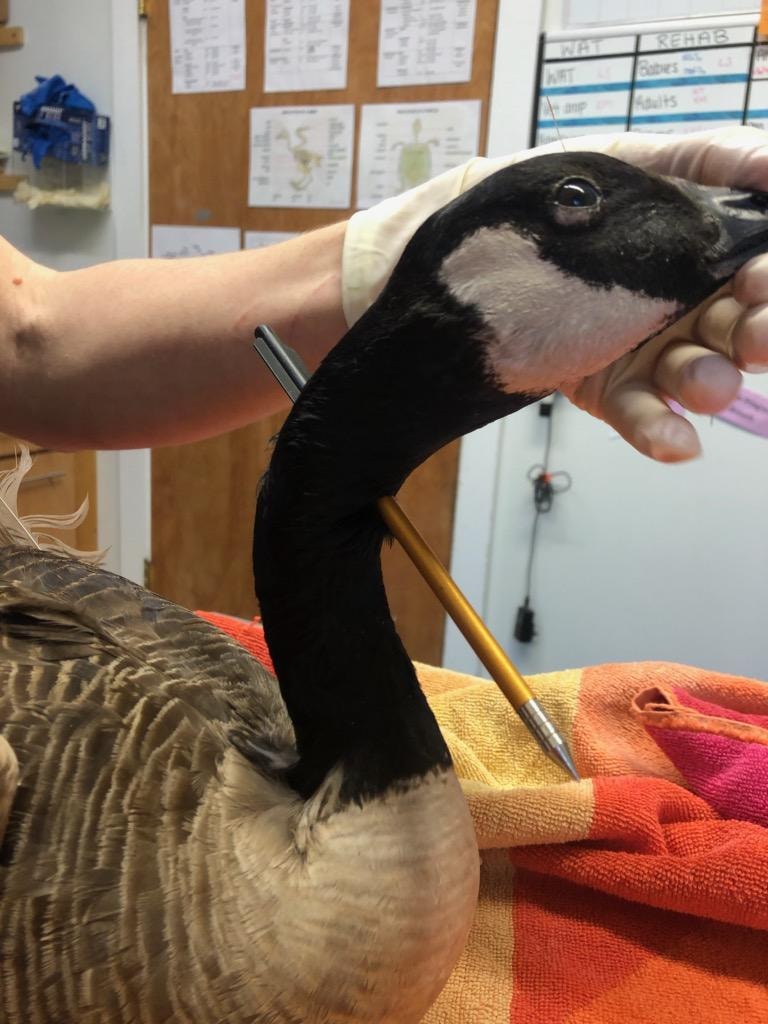
HumaneLI rescued this goose using a netgun after she was shot with an arrow in Wantagh (Pictured at wildlife Center of LI)
What Humane Long Island is doing to help
Leading campaigns to stop mass killings before they happen
After campaigns led by Humane Long Island, North Hempstead officials scrapped plans to massacre 600 geese; Islip UFSD ended an 8-year tradition of hiring Wildlife Services to execute hundreds of geese annually on school properties; the Lake Ronkonkoma Advisory Board pursued birth control rather than slaughter; and Brightwaters and Cornwall-on-the-Hudson committed to pursue only humane, nonlethal geese management.
East Hampton, Southampton, Brookhaven, Riverhead, and Shelter Island canceled plans to hire Wildlife Services to kill ~5,000 deer on the East End following a campaign by Humane Long Island and our friends at the Wildlife Preservation Coalition of Eastern Long Island.

Advising communities on non-lethal Solutions: Ending the Cycle Without Killing
Humane Long Island is helping communities live safely alongside wildlife—without resorting to killing.
Across Long Island, residents face challenges with deer, geese, raccoons, and other wildlife. Traditional lethal control methods often fail, creating a cycle of repeated conflict, high costs, and unnecessary suffering. Humane Long Island provides municipalities, schools, and homeowners’ associations with science-based, non-lethal strategies to break this cycle.
Our Approach Includes:
-
Habitat Modification – Redesigning landscapes to reduce wildlife attractants. (i.e., riparian buffers, native plantings)
-
Exclusion Techniques – Installing barriers like fencing and netting to protect gardens, parks, and property.
-
Community Education – Educating residents on how to coexist safely: securing trash, avoiding feeding, and monitoring wildlife activity. (i.e., public meetings, media outreach, free signage)
- Fertility Control – Implementing humane population-stabilizing methods where feasible. (i.e., egg oiling, PZP)
Why It Works
Non-lethal solutions are safer, more effective, and cost-efficient than killing. They address the root causes of conflicts, prevent repeated cycles, and protect wildlife while keeping communities secure.
“Ending the cycle without killing isn’t just humane—it’s smart wildlife management.”
Communities across the country are discovering that humane, non-lethal approaches can effectively reduce human-wildlife conflicts—without triggering endless cycles of killing or wasting taxpayer dollars.
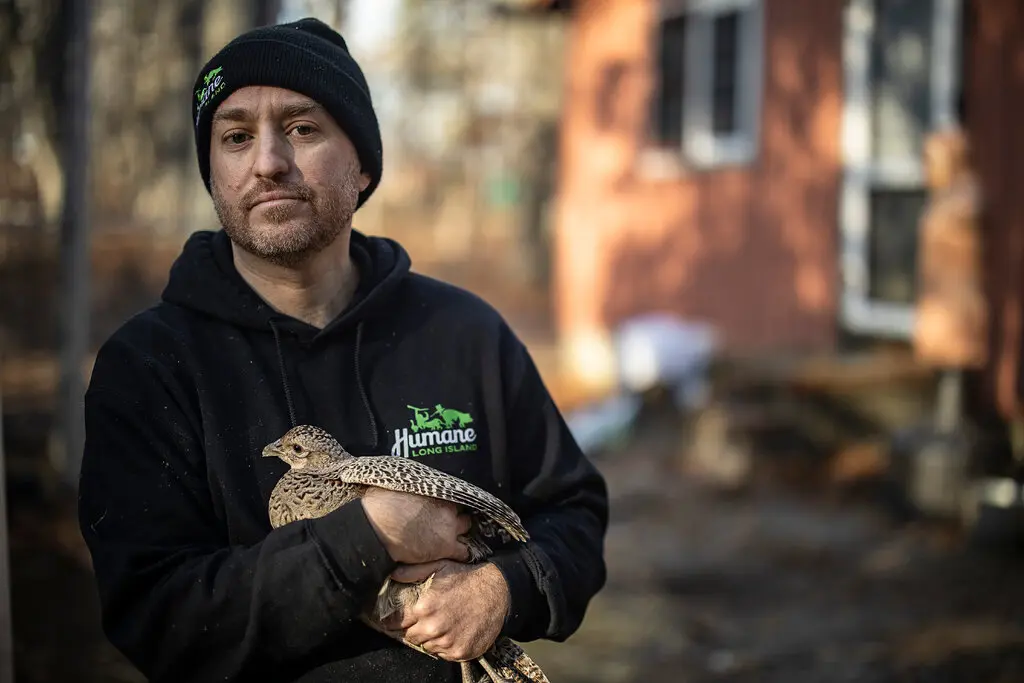
Campaigning to repurpose $1.4 million conservation fund dollars from canned pheasant hunting to grants for reputable wildlife rehabilitators
Humane Long Island is working with Assemblymember Linda Rosenthal to reintroduce legislation to stop the state from sponsoring this cruelty and calling on New York to redirect the $1.4 million currently spent on this state-sponsored cruelty toward grants for reputable wildlife rehabilitation.
International Duck Defenders program & Steering the National Goose protection Coalition
Humane Long Island’s international Duck Defenders program is the leading resource for domestic waterfowl rescue and advocacy in North America and advises agencies across the continent about how to amicably resolve issues concerning ducks and geese.
In 2022, Humane Long Island and its Duck Defenders program were honored to receive the National Goose Protection Coalition’s inaugural Golden Goose Award, and Humane Long Island’s executive director now serves on the steering committee for the coalition—which provides resources, education, and advocacy tools for people who want to help geese in their communities via non-lethal means of resolving human-geese conflicts. In 2025, John presented to more than 70 recreation and parks officials about non-lethal geese mitigation at the National Recreation and Parks Association Conference in Orlando, FL.
building bridges with USDA APHIS Wildlife Services
After Save the Geese Bloomsburg sounded the alarm that USDA APHIS Wildlife Services would be removing up to 70 ducks from Fairground Road Park in East Buffalo Township, Humane Long Island’s Duck Defenders program offered a solution beneficial for both the ducks and the community: working in cooperation with Wildlife Services to humanely relocate the domestic ducks to reputable homes and sanctuaries.
Following a successful effort in East Buffalo Township, this burgeoning relationship between Humane Long Island and Wildlife Services will likely save the lives of many more domestic ducks and geese to come.
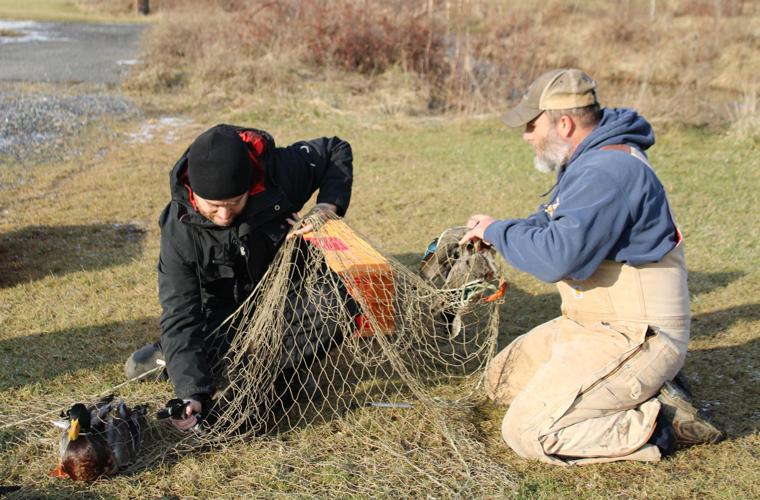
Like geese, we fly further together
HumaneLI Executive Director John Di Leonardo and USDA APHIS Wildlife Services Wildlife Biologist Kyle Van Why work cooperatively to untangle ducks from a net at Fairground Road Park in East Buffalo Township.
Photo Credit: Jim Diehl / The News-Item
References
-
Côté, S.D., et al. (2004). Ecological impacts of deer overabundance. Annual Review of Ecology, Evolution, and Systematics, 35, 113–147.
-
State Farm Mutual Automobile Insurance Company. (2022). Annual Animal Collision Report. See also: DeNicola, A.J. & Williams, S.C. (2008). Managing White-Tailed Deer in Suburban Environments. Cornell Cooperative Extension.
-
Kellert, S.R. & Berry, J.K. (1980). Knowledge, affection, and basic attitudes toward animals in American society. U.S. Fish & Wildlife Service; Minnesota DNR Bowhunting Wounding Report (1999).